
What this guide helps you decide
A practical guide to household pest clues in Albuquerque, with identification limits and useful next steps.
Use the guidance to record useful evidence and prepare questions.
The actual pest, property, product, and treatment method determine what applies to your situation.
Start with the location
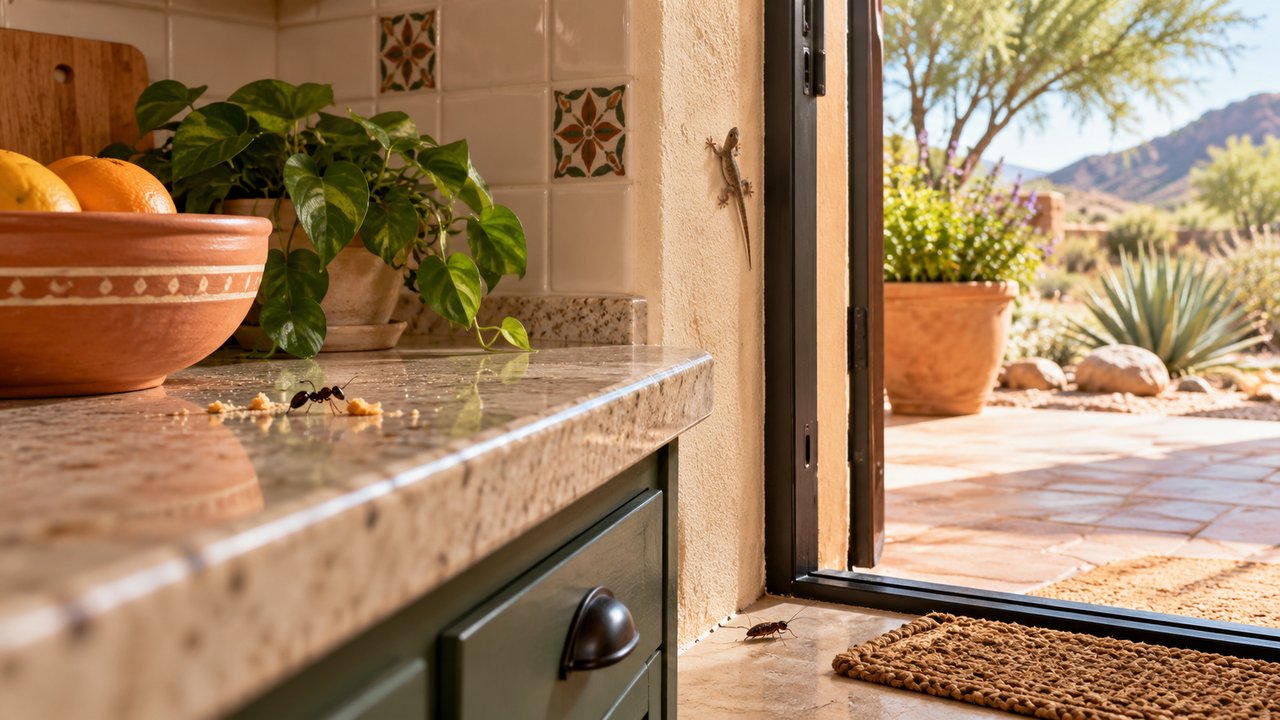
Kitchen activity brings food storage, water, cabinet gaps, and appliance areas into the discussion.
Ant trails, cockroaches, and stored-product insects can all appear there, but their sources and treatment needs differ.
A garage report may involve rodents, occasional insects, or wildlife access.
A bedroom complaint may need investigation of bed bugs, fleas, or another cause; skin marks alone cannot identify the pest.
Outside, water-holding containers, sheltered edges, nesting sites, and damaged screens can matter.
Use the location to ask better questions rather than select a pesticide immediately.
Ants and cockroaches need different investigations
Ant trails can show a route to food or moisture, while the colony may be elsewhere.
Record the route and conditions before repeated cleaning or spraying obscures useful clues.
Cockroach activity may involve indoor breeding, a moist hiding place, or an occasional exterior visitor.
Repeated sightings, young insects, and activity in several rooms deserve a closer assessment.
Calling every small insect an ant or every dark insect a roach can lead to the wrong response.
A clear photo and the original location help narrow the possibilities.
Rodent evidence deserves careful handling
Droppings, gnawing, and nesting material can suggest rodents, but they do not reveal every occupied space.
Entry routes and accessible shelter should be considered with the visible evidence.
Do not dry sweep or vacuum suspected rodent waste.
Cleanup precautions differ from normal household dusting, and heavy contamination may need specialist help.
Control and repair also have different jobs.
Removing activity without considering the openings can leave a route available for another animal.
Biting and stinging complaints have limits
Bed bugs, fleas, mosquitoes, and other causes can produce complaints that sound similar on a phone call.
Physical evidence is more informative than assuming an insect from a skin response.
Spiders, scorpions, and wasps should be observed without handling them.
Report where activity occurs and whether it affects an entrance, sleeping area, or occupied outdoor space.
Concerning symptoms belong with a healthcare professional.
Pest identification and property service do not replace medical assessment.
Seasonal insects are not all infestations
Crickets, earwigs, boxelder bugs, silverfish, and other occasional invaders have different habits.
Some enter from outdoors; others may be associated with stored materials or indoor conditions.
Weather and watering can change what you notice.
That does not establish a predictable infestation calendar for every Albuquerque home.
Explain whether insects are gathering outside, entering through a particular opening, or appearing throughout the building.
These distinctions help define a useful inspection.
Build a simple evidence record
Make a short note with the date, room or outdoor location, approximate number, and any photograph.
Include recent leaks, deliveries, travel, used furniture, or building changes when relevant.
Tell the provider what products have already been applied.
Several overlapping treatments can create exposure and make the original pattern harder to assess.
The aim is a focused plan: identify the activity, inspect relevant areas, choose appropriate measures, and review the evidence afterward.
An example of turning a sighting into a useful question
Suppose you find a small dark insect beside a cabinet.
The useful next question is not immediately which spray to buy.
Ask whether it has appeared before, whether there are immature insects, and whether food or moisture is nearby.
Now suppose you hear scratching in the garage.
That changes the evidence and the inspection priorities.
Describe the sound, any droppings or damage, and accessible food storage without entering a hazardous void.
These examples show why a pest catalogue is a starting point.
The location and recurrence help select a service, while identification and inspection establish the actual scope.
Keep treatment and property work connected
Ask how the proposed work relates to housekeeping, leaks, access gaps, and storage.
Some actions may be simple household maintenance, while others need a manager or separate contractor.
A service record should let you identify what was assessed, what was selected, and what new evidence matters.
If the pattern changes, explain that change rather than assume the same pest is always responsible.
This approach is useful across Albuquerque properties without claiming that every neighborhood has the same infestation rate or seasonal problem.
Your building and evidence are the basis for a decision.
Your practical checklist
- Record the original location and date
- Photograph safely without handling unfamiliar pests
- Note food, water, shelter, and entry conditions
- List recent pesticides and building changes
- Ask what the inspection and treatment quote includes
Prepare an informed service enquiry
A useful enquiry explains the original activity, the property type, and how often it has appeared.
Include any recent maintenance, deliveries, travel, or product use that relates to the concern.
Have the address and access arrangements ready.
For rental or shared properties, identify the person who can authorize the work and coordinate relevant spaces.
Ask what the inspection can establish, which areas are accessible, and what limitations apply.
Confirm the treatment scope, preparation, follow-up, and separately quoted work before making a decision.
Common questions
Is one insect proof of an infestation?
No.
Species, location, recurrence, and other evidence determine what needs investigation.
Should I spray before calling?
Explain the activity and recent product use first.
A treatment chosen without identification may miss the source.
Can every pest be covered by one service?
General treatment and specialist work have different scopes.
Ask about the specific pest and property.
Sources and further reading
Public sources checked October 9, 2026.
Sources from other regions support general pest guidance; they do not establish Albuquerque infestation rates.