
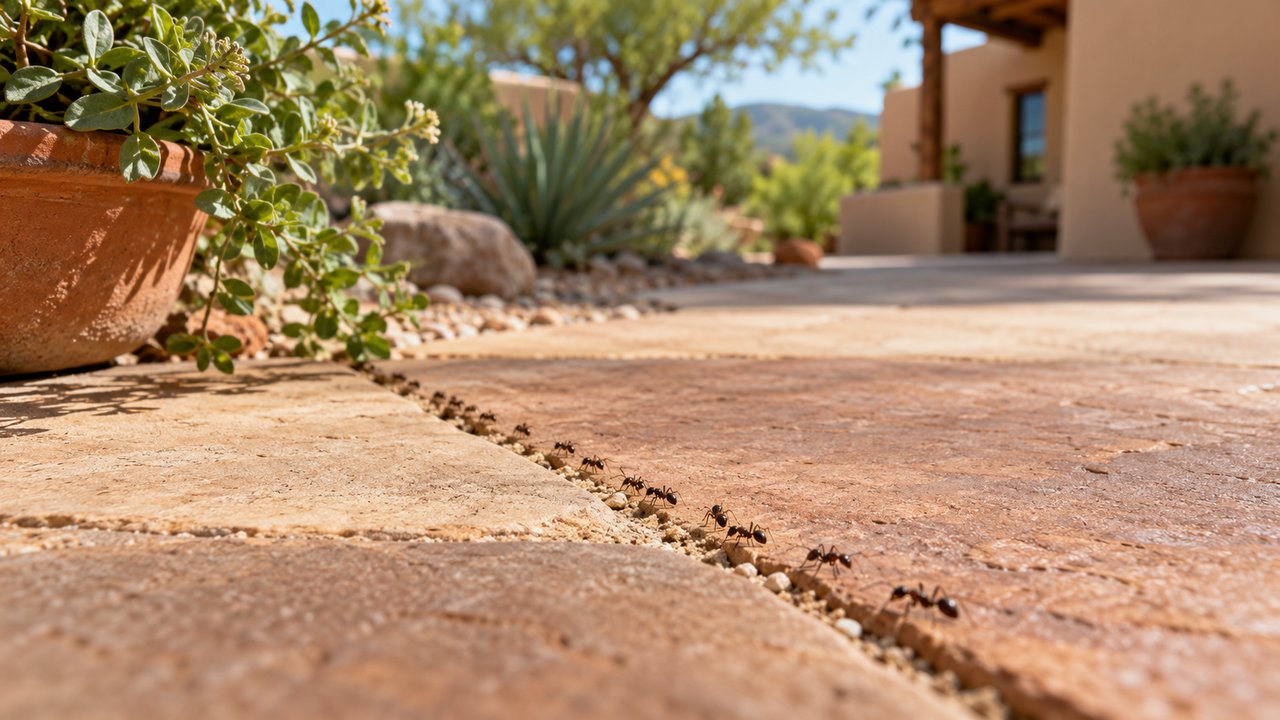
Follow the clues without disturbing the trail
Where ants travel can help explain why they are entering.
A trail near a sink may indicate a different attraction from activity around a patio, planter, or food-storage shelf.
Ant species differ in nesting and feeding behavior.
A treatment appropriate to one situation may be ineffective or counterproductive in another.
Photograph the trail and note the time of day, location, and nearby food or water.
Avoid repeatedly spraying the route before an assessment, because that may change the visible pattern.
Treatment should match the activity
Ant service can include identifying the insects, examining accessible routes, looking for nest clues, and selecting targeted treatment.
Baits, other applications, and exclusion recommendations depend on the situation.
Exterior activity matters when colonies are outside and workers are entering to forage.
Interior-only treatment may leave the source or supporting conditions unresolved.
Do not assume every ant in a yard requires treatment.
The scope should focus on the problem and property use, with attention to exposure and label requirements.
Prepare food and water areas
Keep food sealed and wipe up spills.
Make the affected cabinet edges, sinks, and thresholds accessible without removing evidence unnecessarily.
Tell us about pets, aquariums, and any bait or pesticide already applied.
Interfering products can affect the proposed method.
If bait is selected, follow instructions about cleaning around placements and adding other products.
More treatment is not automatically better.
Why trails may return
A nearby colony, a moisture issue, a new food source, or an untreated access route can sustain activity.
Monitoring helps distinguish a new problem from a response still developing.
Treatment timing varies with the species and method.
We do not promise that all trails disappear immediately or that one visit resolves every colony.
Report changes with dates and locations.
Ask which maintenance items, such as threshold repairs or leak correction, should accompany the treatment plan.
Make an ant enquiry specific
A line of ants crossing a kitchen counter and ants nesting beside an outdoor planter may be connected, or they may be separate activity.
Describe both locations and any visible movement between them.
Do not assume ants are nesting exactly where they are found.
Workers can travel, and the accessible inspection may need to consider the exterior as well as the room.
Where treatment involves bait, monitoring looks at attraction and changes in activity.
An ignored placement and a placement that workers visit require different interpretation, so report what you actually observe.
Ask how treatment should be protected from cleaning, pets, children, and other products.
Instructions should explain what you can maintain normally and what needs to remain undisturbed.
If the insects have wings or wood damage is involved, say so when you call.
Identification may change the service from a general ant concern to another specialist assessment.