
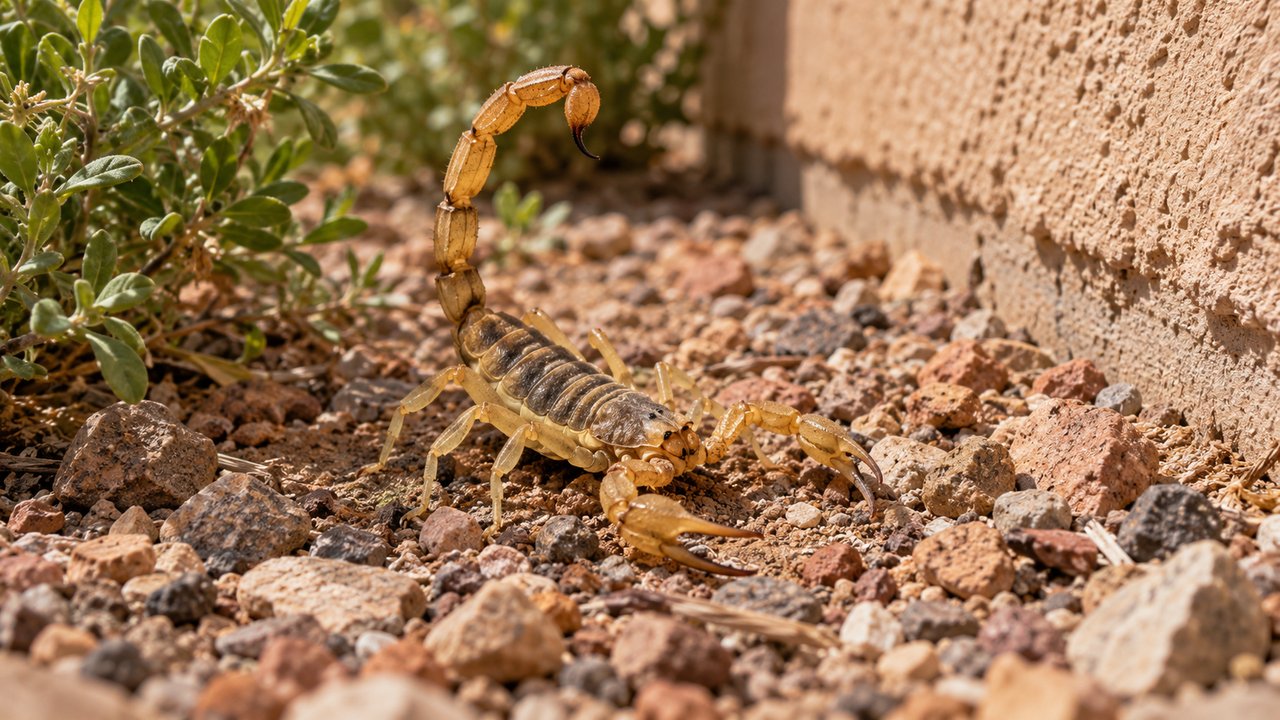
Assess activity without handling scorpions
Location and recurrence matter.
An occasional outdoor sighting and repeated indoor activity should prompt different questions about shelter and access.
Photograph from a safe distance and note the place and time.
Do not pick up a scorpion or move heavy debris to look for more.
New Mexico has multiple scorpion species.
We do not assume a particular species or level of medical risk from the fact that an animal was seen in Albuquerque.
Address shelter, prey, and entry
Scorpion management may involve inspecting accessible edges, assessing shelter and insect prey, and selecting appropriate treatment.
Block-wall joints, door thresholds, utility gaps, stored items, and landscaping can be relevant.
Exclusion recommendations should identify actual openings rather than rely on a general promise.
Complete prevention in an outdoor desert environment cannot be guaranteed.
The practical aim is to address the property conditions and monitor the response.
Prepare safely for the visit
Tell us about the most recent sightings and any pest products used.
Keep gates and ordinary work areas accessible, but leave risky searches or debris disturbance to appropriate professionals.
Share information about children, pets, sensitive areas, and access restrictions.
Precautions and re-entry depend on the proposed method.
Do not use improvised pesticide mixtures or blanket indoor applications.
More chemical exposure does not establish better scorpion control.
Support the plan with maintenance
Reduce unnecessary ground-level storage and address relevant access gaps.
Discuss how landscape shelter and insect activity relate to the findings.
Ongoing monitoring may be useful where activity persists.
Record sightings so follow-up can focus on actual patterns.
If a sting causes concerning symptoms, seek medical assistance promptly.
Pest service addresses the property and does not provide diagnosis or treatment for stings.
A practical response to repeated sightings
If sightings cluster around a doorway, note the threshold and the adjacent exterior shelter.
If they occur across several rooms, explain the wider pattern and any other insect activity.
Do not assume a species from a photograph with poor scale or lighting.
A clear safe-distance image can support the discussion, while an inspection considers the property conditions.
Exclusion work needs to preserve the building's functions.
Discuss door sweeps, screens, and accessible penetrations without closing necessary vents or drainage.
Where a treatment is selected, ask about the areas, precautions, and evidence needed for follow-up.
More application is not a substitute for understanding the pattern.
Keep pets and people away from an observed animal and do not disturb potential shelter to search for more.
Call with the location so the assessment can begin with useful evidence.