
What this guide helps you decide
Practical guidance for shelter, entry gaps, safe observation, and discussing scorpion activity without assuming species.
Use the guidance to record useful evidence and prepare questions.
The actual pest, property, product, and treatment method determine what applies to your situation.
Do not assume the species
New Mexico has more than one scorpion species.
Location alone is not enough to identify the animal or establish its medical significance.
A safe-distance photograph and a record of where it appeared can help an assessment.
Do not pick it up or trap it by hand.
If a sting causes concerning symptoms, seek medical advice.
A pest inspection concerns the property and does not diagnose a person's response.
Look at the pattern of activity
One outdoor sighting and repeated indoor sightings raise different questions.
Record the dates, locations, and whether the same access area is involved.
Activity around thresholds, wall joints, sheltered edges, or stored materials can help guide inspection.
The relevant conditions depend on the property.
Do not conduct a risky search beneath heavy objects or inside dark voids.
Tell the provider about suspected shelter rather than disturb it yourself.
Review accessible entry gaps
Ordinary threshold defects, damaged screens, utility penetrations, and other accessible openings may be worth checking.
Exclusion needs to fit the building.
A gap should not be sealed if doing so blocks necessary drainage or ventilation.
Material choice and maintenance access also matter.
Ask which repairs belong in the pest service and which need a separate contractor.
A clear scope is more useful than a general claim that a home will be sealed completely.
Manage shelter without unsafe disturbance
Reduce unnecessary storage at ground level where ordinary housekeeping can be performed safely.
Keep work areas accessible and discuss larger debris or suspected occupied shelter.
Landscape features and exterior insect activity may be relevant, but not every outdoor feature needs removal.
Recommendations should follow the inspection.
The surrounding environment remains outside a home's complete control.
Prevention cannot guarantee that no scorpion will ever appear again.
Discuss treatment and exposure
Appropriate methods depend on identified activity, locations, and product directions.
More pesticide is not automatically a better response.
Tell the provider about children, pets, water features, and products already used.
Preparation and re-entry need to match the actual method.
Avoid homemade pesticide mixtures or blanket indoor applications.
Follow registered-product instructions and keep treatments coordinated.
Make follow-up useful
Keep a short activity record after service.
Report continued or relocated sightings with their timing and location.
Ask how the treatment will be reviewed and whether underlying insect activity or maintenance needs attention.
Repeating the same application without understanding the pattern may miss an important condition.
A sound plan connects inspection, appropriate control, exclusion, and monitoring.
It explains its limits while giving you clear next steps.
Use the sighting location to focus the enquiry
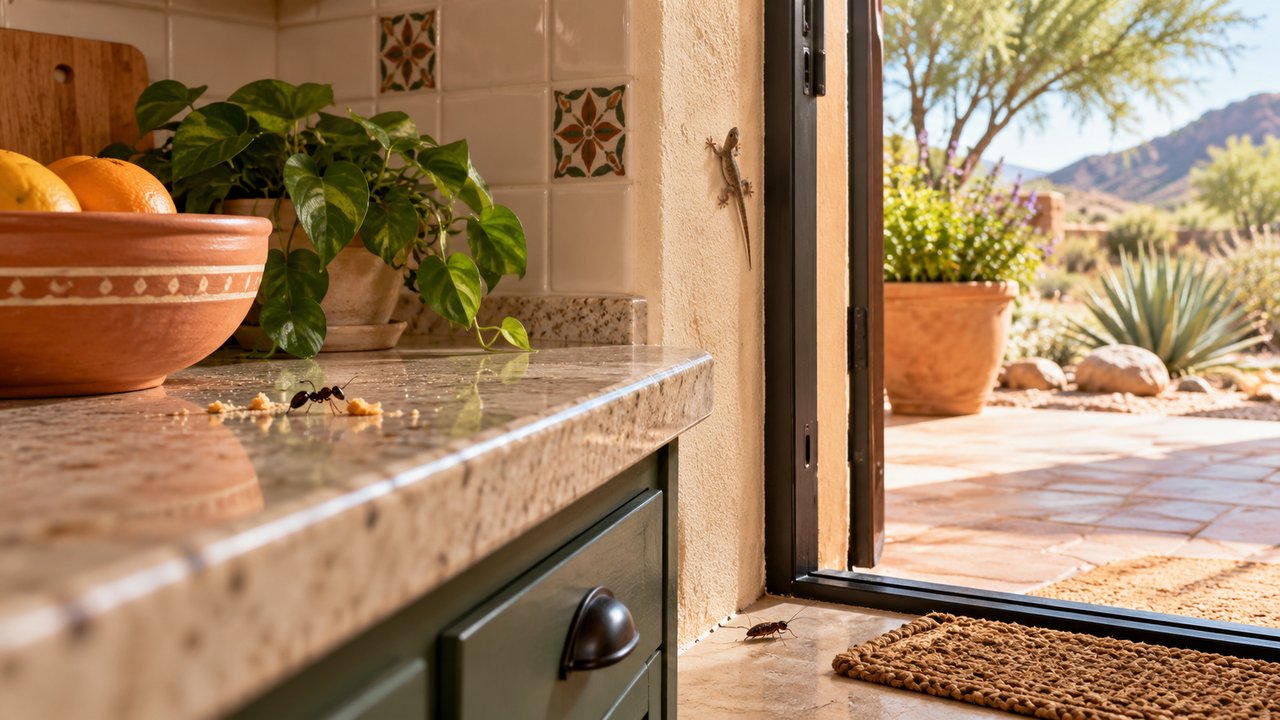
Imagine scorpions repeatedly appear just inside one threshold.
Photograph the ordinary doorway conditions and note the nearby shelter without disturbing it.
If sightings occur across several rooms, describe the broader pattern.
A single doorway repair may not answer the entire concern, and related insect activity may need assessment.
In both cases, identification and the property findings guide the response.
Do not assume a particular species or hazard level from an online image.
Keep maintenance practical and safe
Accessible screen or sweep repairs can be ordinary maintenance, while concealed shelter, heavy materials, and unusual access need a different plan.
State those limits when arranging work.
Ask how treatment precautions and exclusion recommendations fit your household.
Tell the provider about pets and children before the method is chosen.
After service, record new sightings with their location rather than chase animals or add pesticides.
A review can then assess fresh evidence, entry conditions, and whether the original scope needs adjustment.
Your practical checklist
- Observe and photograph without handling
- Record repeated indoor and outdoor locations
- Review accessible thresholds and screens
- Avoid disturbing heavy or concealed shelter
- Share pets, children, and recent pesticide use
- Clarify exclusion and follow-up scope
Prepare an informed service enquiry
A useful enquiry explains the original activity, the property type, and how often it has appeared.
Include any recent maintenance, deliveries, travel, or product use that relates to the concern.
Have the address and access arrangements ready.
For rental or shared properties, identify the person who can authorize the work and coordinate relevant spaces.
Ask what the inspection can establish, which areas are accessible, and what limitations apply.
Confirm the treatment scope, preparation, follow-up, and separately quoted work before making a decision.
Common questions
Is every scorpion in Albuquerque the same?
No.
Species should not be assumed from location alone.
Should I move rocks to look for them?
Avoid risky shelter disturbance or handling.
Explain suspected locations when arranging assessment.
Can prevention guarantee no future sightings?
No.
Outdoor exposure varies.
The plan should address relevant property conditions and monitoring.
Sources and further reading
Public sources checked October 9, 2026.
Sources from other regions support general pest guidance; they do not establish Albuquerque infestation rates.