What this guide helps you decide
Learn where to look for accessible rodent entry gaps and why exclusion needs to be coordinated with control.
Use the guidance to record useful evidence and prepare questions.
The actual pest, property, product, and treatment method determine what applies to your situation.
Small openings can matter
CDC notes that mice can fit through openings about one-quarter inch wide, roughly the width of a pencil.
This helps explain why a small utility gap deserves attention.
It is not a rule that every visible gap is being used.
Fresh evidence, construction details, and the animal involved help determine the priority.
Measure and photograph from a safe position.
Do not enter a roof space or move contaminated material just to confirm the opening.
Check the ordinary access points
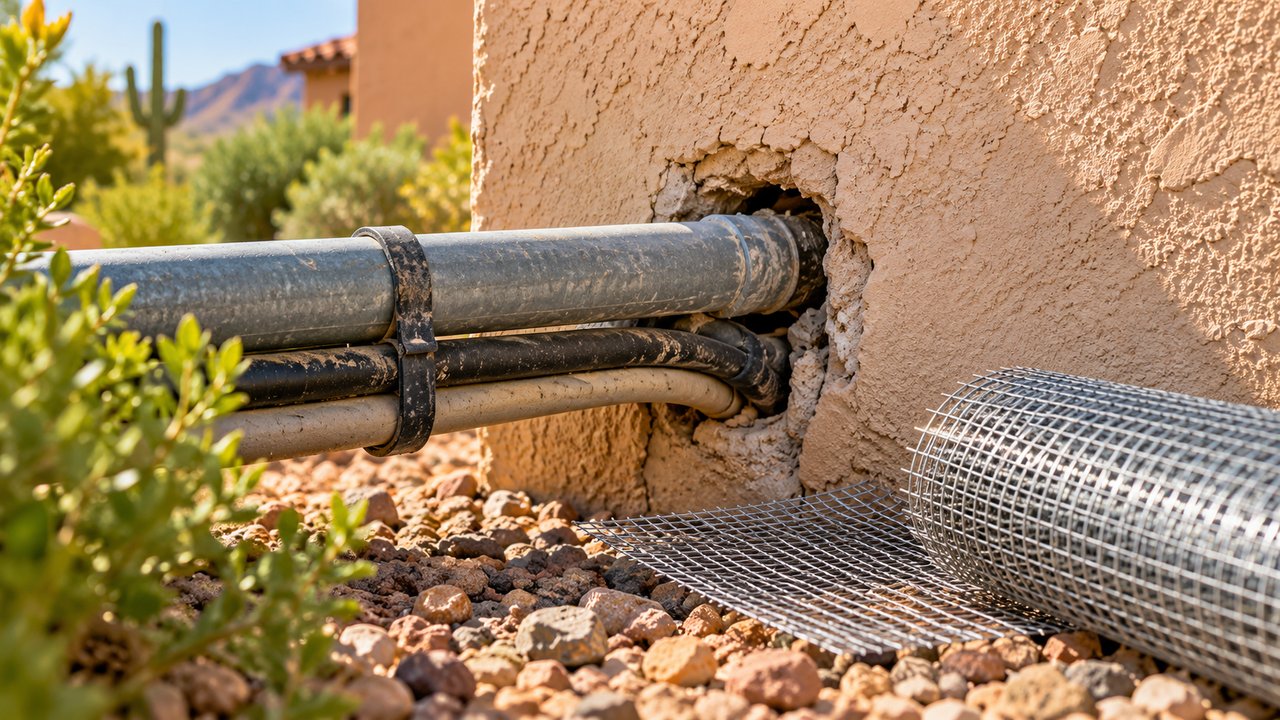
Door thresholds, garage edges, pipes, cables, vents, and accessible foundation joints are useful places to review.
Different openings require different repair details.
A damaged door sweep can be easier to overlook than a large hole.
Pay attention to corners and the way the door closes.
Screens and vent coverings must allow necessary airflow.
Exclusion should not block ventilation, drainage, or appliance operation.
Connect entry evidence with interior activity
Droppings, gnawing, nesting material, and sounds can guide inspection.
An exterior gap becomes more meaningful when the nearby interior also has evidence.
Keep notes of the original locations.
Cleaning suspected rodent waste requires precautions, so do not dry sweep the evidence away.
Multiple openings may be relevant.
Repairing only the most obvious one may leave other access routes unaddressed.
Coordinate removal and repair
Closing an occupied void prematurely can trap an animal, leave young behind, or redirect movement within the building.
The sequence should be assessed.
Appropriate control methods and monitoring help clarify whether activity remains.
Repairs can then be planned with the findings in mind.
Ask which parts of exclusion are included in the quote and which require another contractor.
Roof work, major openings, and building damage may be separate.
Use suitable materials
The repair should fit the opening and resist the identified animal while maintaining building function.
A casual fill with any available material is not automatically a durable solution.
Utility connections, movement joints, moisture, and future maintenance access all matter.
Avoid making structural or electrical changes without the right expertise.
Inspect repairs periodically for damage or new openings.
A completed exclusion job does not remove the need for normal building maintenance.
Reduce food and shelter too
Closed food and animal-feed storage, managed waste, and tidy accessible storage support the control plan.
Entry repair alone does not remove every attraction.
Outside feeding, clutter, and shelter should be reviewed in context.
Do not disturb wildlife or contaminated nests during routine tidying.
Report new evidence after repairs.
The useful question is whether fresh activity continues, not whether old marks remain visible.
An opening is a question, not automatic proof
Imagine a small gap appears beside a pipe while fresh droppings are found in the nearby garage.
The combination gives an inspector a useful location to assess.
If the same gap has no accompanying evidence, it may still need maintenance, but that does not prove it is the route used.
Other openings or concealed paths may be relevant.
Keep the observations separate: what you measured, what you found, and where it occurred.
This avoids turning a plausible route into an unsupported conclusion.
Agree how repairs will be checked
Ask which material and repair detail suit the opening, who performs the work, and whether activity needs control before closure.
Preserve required ventilation and access.
After repair, monitor for fresh signs and check for damage during routine maintenance.
Old gnawing or stains should not be mistaken for new activity without evidence.
A practical exclusion plan is connected to control and monitoring.
It explains accessible findings and limitations instead of promising that a quick exterior walk revealed every possible route in the building.
Your practical checklist
- Review thresholds and garage corners
- Photograph accessible utility and vent gaps
- Record nearby interior evidence
- Avoid dry sweeping suspected waste
- Coordinate control before closing occupied spaces
- Clarify materials and repair responsibilities
- Monitor for fresh activity
Prepare an informed service enquiry
A useful enquiry explains the original activity, the property type, and how often it has appeared.
Include any recent maintenance, deliveries, travel, or product use that relates to the concern.
Have the address and access arrangements ready.
For rental or shared properties, identify the person who can authorize the work and coordinate relevant spaces.
Ask what the inspection can establish, which areas are accessible, and what limitations apply.
Confirm the treatment scope, preparation, follow-up, and separately quoted work before making a decision.
Common questions
Can mice use very small gaps?
CDC notes openings around one-quarter inch can be sufficient.
Actual use still requires assessment.
Should I seal every hole immediately?
Coordinate suspected occupied spaces with control first, and preserve required airflow and drainage.
Is spray foam always enough?
No.
Animal resistance, opening size, conditions, and building function determine appropriate repair materials.
Sources and further reading
Public sources checked October 9, 2026.
Sources from other regions support general pest guidance; they do not establish Albuquerque infestation rates.